

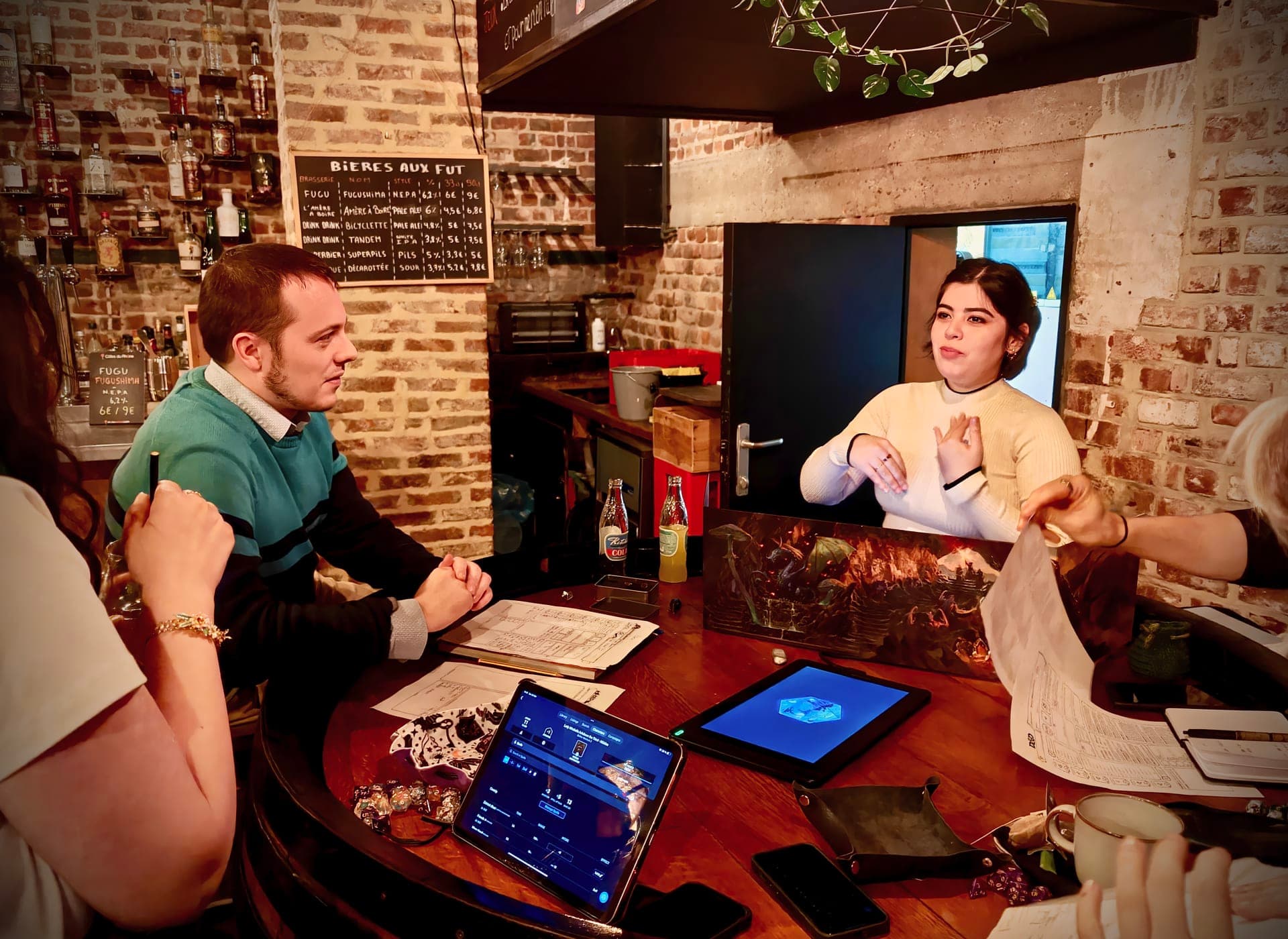
Finding a TTRPG Group in Brussels: The Expat's Guide

Azaphyr
DM & Creative Workshop Master
July 24, 2026
Moving to a new city means rebuilding everything: your commute, your coffee spot, and, if you play tabletop RPGs, your group. Trying to find a D&D group in Brussels as a newcomer can feel oddly difficult for a city this size and this international. The information is scattered, half of it is outdated, and much of the rest assumes you speak French. Here is the guide we wish someone had handed us on arrival: every route to a TTRPG group in Brussels that actually works, ranked by how fast it gets you rolling dice.
Why finding an RPG group in Brussels feels harder than it should
Brussels has a genuinely large player base. Between locals who grew up on French-language RPG culture and an enormous international population orbiting the EU institutions and NATO, there are more than enough players and Game Masters here for everyone to have a table.
The problem is churn. Expat-heavy cities eat gaming groups alive: a group forms, plays brilliantly for eight months, then a contract ends, two members move countries, and the group dissolves. What survives online is the residue: recruitment threads years out of date, community pages that stopped posting, chat servers gone quiet. If your search results feel like an archaeological dig, that is why. The fix is to start with structures that outlive individual members, then build your regular group from the people you meet there.
The fastest way to join a D&D group in Brussels
Skip the cold-calling entirely and start with drop-in game nights. Tales of Bruss'Hell, a Brussels non-profit (ASBL) that promotes tabletop RPGs, runs an open game night every weekend at a rotating network of partner venues, bars and bookshops, across Brussels. The venue changes weekly and the network keeps expanding into new neighbourhoods.
The format is built for newcomers. Every table is published online before the night, showing its language, experience level, and game system, so English speakers can pick English-run tables with confidence: a significant share of tables run in English with international GMs and players. A table seats one GM plus three to six players and runs three to four hours. Most nights are free; some venues ask around 5 euros per seat to cover the room, and any price is shown at booking. There is no membership requirement to play (an optional membership exists purely to support the association). Beginner-friendly tables are flagged, and intro tables provide all materials.
In other words: instead of searching for a group, you browse our upcoming game nights, book a seat, and you are playing D&D in Brussels this weekend, with zero commitment beyond one evening.
The rotating venues also solve a quieter problem: geography. In a city of nineteen communes, a fixed clubhouse is always on the wrong side of town for someone. Because the game nights move across Brussels week by week, and the partner network keeps adding new neighbourhoods, the scene comes to you at least some of the time, instead of you always crossing the city for it.
The clubs: established D&D groups in Brussels
If you want the classic long-campaign experience with a fixed roster, Brussels has established clubs with real staying power, among them Les Saigneurs du Chaos, Les Portes de Salem, and La Ligue des Jeuxsticiers. They are welcoming, well organized, and mostly French-speaking. For francophone newcomers they are an excellent home; for English speakers they work best either once your French is conversational, or as motivation to get it there. Playing an RPG in your second language is, genuinely, one of the fastest ways to improve it.
For a countrywide view, the D&D Belgium network maps clubs and playing locations across Belgium, which is handy if you live near the edge of the region or commute to another city.
Game shops and festivals: the physical scene
Brussels' game shops are more than retail; they are where the community physically gathers. Dédale and Ludotrotter serve the local scene, and Outpost Brussels is a fixture for the international crowd. Shop staff tend to know what is running locally, and notice boards (physical and digital) still work in 2026.
Once a year, the Brussels Games Festival puts the city's whole gaming culture in one place. It skews toward board games, but it is an efficient way to meet the tabletop community in bulk and discover associations you did not know existed.
Online: Discords and expat communities
Brussels' expat communities and general gaming Discords do produce groups, and some excellent ones. Two rules keep you from wasting weeks there. First, check the timestamp: if the last message in a "looking for players" channel is months old, move on. Second, prefer communities attached to a real-world structure (an association, a shop, a recurring event) over free-floating groups, because they survive member turnover.
A note on timing, too: Brussels runs on an expat calendar. Early autumn, when traineeships and new postings begin, is when the most new players appear online and the most new groups form. If you arrive in September, you are arriving at the best possible moment. If you arrive in any other month, the weekend game nights are the one part of the calendar that never goes quiet.
If your priority is specifically playing in English, we wrote a dedicated guide on how to play D&D in English in Brussels, covering languages at the table, costs, and beginner options in more depth.
How to turn one-shots into a regular D&D group in Brussels
The weekend game nights are not just a stopgap until you find "a real group"; they are the best recruitment pool in the city. A repeatable pattern:
- Play several nights in a row. Faces repeat. The scene in Brussels is smaller than the city, and after three or four sessions you will know a dozen players.
- Tell your GM what you are looking for. GMs are the connective tissue of the hobby. Someone running weekly public tables knows who else wants a long campaign.
- Exchange contacts the same evening. The classic expat mistake is a great session followed by silence. Get the Discord handle or number before you leave the venue.
- Offer to host or to run. Groups crystallize around whoever provides the two scarce resources: a table to sit at, or a GM behind the screen. If you can be either, you will never lack players in Brussels.
Because the association's nights recur every weekend, your fledgling group also has a fallback: any week your home campaign cannot meet, you can each book into a public table and keep the habit alive.
A 15-minute action plan
If you do only this, you will be playing within a week:
- Read our complete guide to tabletop RPG in Brussels for the full lay of the land.
- Book a seat at the next weekend game night that matches your language and level.
- At the table, mention you are new in Brussels and looking for a regular group. That sentence, said out loud at a real table, outperforms every forum post ever written.
The hardest part of finding a TTRPG group in Brussels is not the scarcity of players. It is that the front door was never clearly marked. Consider it marked.
Related Posts

What Is a Tabletop RPG, Exactly?
Jul 24, 2026